Key Variant vs Key Block: A Simple Explanation

In payment security and cryptography, we often hear terms like key variant and key block. Both are related to how cryptographic keys are used and protected, but they are not the same thing.
A simple way to understand it:
Key variant is about modifying how a key is used.
Key block is about securely packaging and protecting the key itself.
What Is a Key Variant?
A key variant is a method where one cryptographic key is slightly modified to create another key for a specific purpose.
For example, one master key may be used to derive different working keys, such as:
| Purpose | Example |
|---|---|
| PIN encryption | Used to protect PIN data |
| MAC generation | Used to generate message authentication codes |
| Data encryption | Used to encrypt transaction data |
The idea is simple: instead of using the exact same key for everything, the system applies a variation to the key so it can be used for a specific function.
Simple Example of Key Variant
Imagine you have one master key:
Master Key = ABCD1234Then the system creates different variants:
PIN Key Variant  = ABCD1234 + PIN usage variation
MAC Key Variant  = ABCD1234 + MAC usage variation
DATA Key Variant = ABCD1234 + DATA usage variation
Of course, in a real cryptographic system, the process is not this simple. The variation is done using a proper cryptographic method, not by adding text like above.
But conceptually, the idea is:
Same base key, different usage.So, a key variant helps separate the purpose of a key.
What Is a Key Block?
A key block is a secure format used to store, transport, or exchange cryptographic keys.
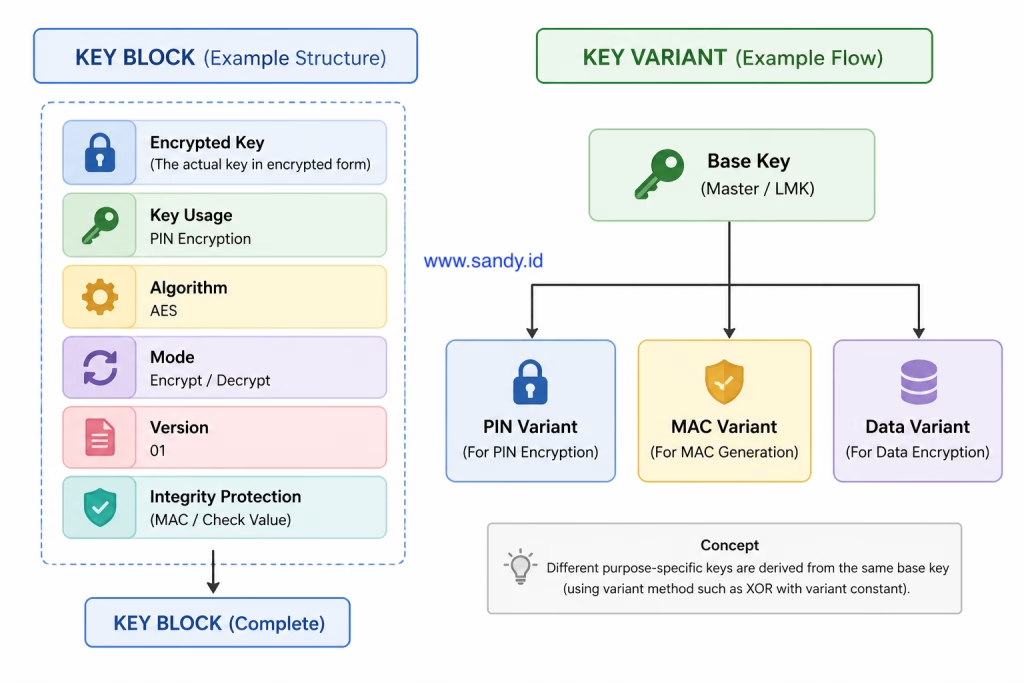
A key block does not only contain the encrypted key. It also includes information about the key, such as:
| Information | Example |
|---|---|
| Key usage | PIN encryption, MAC, data encryption |
| Algorithm | AES, 3DES |
| Mode of use | Encrypt, decrypt, generate, verify |
| Key version | Version number |
| Protection data | Integrity check or authentication data |
So instead of sending a key alone, a system sends the key inside a protected container.
Simple Example of Key Block
Without key block, a key may look like this:
Encrypted Key = 8F72A91B3C44...The problem is, we do not know much about it.
What is this key for?
Is this key allowed for PIN encryption?
Does the key allow MAC generation?
Is export permitted for this key?
Which algorithm does it use?
A key block packages the key together with its control information:
Key Block
├── Encrypted Key
├── Key Usage: PIN Encryption
├── Algorithm: AES
├── Mode: Encrypt / Decrypt
├── Version: 01
└── Integrity Protection
This makes the key safer and easier to control.
Simple Analogy
Think about a key variant like having one employee ID, but different access levels depending on the room.
Same person, different access purpose.For example:
Access to server room
Access to finance room
Access to archive room
The identity may come from the same source, but the system gives different access levels based on each purpose.
Now think about a key block like putting a valuable item inside a sealed security box.
The box contains:
The item
A label
Usage rules
Tamper protection
Tracking information
So, when someone receives the box, they know what it contains, what usage rules apply, and whether anyone has changed it.
Key Variant vs Key Block
| Area | Key Variant | Key Block |
|---|---|---|
| Main purpose | Separate key usage by variation | Securely package and protect keys |
| Focus | Key derivation or usage separation | Key transport, storage, and control |
| Contains metadata | Usually limited | Yes |
| Protects key integrity | Not by itself | Yes |
| Common use | Legacy payment systems, key derivation | Modern key management and key exchange |
Easy Example
Let’s say a payment system needs three keys:
PIN Key
MAC Key
Data Encryption Key
Using key variant, the system may derive different keys from one base key:
Key Variant

From a single base key, the system derives:

Base key -> PIN key
Base key -> MAC key
Base key -> Data encryption key
With key block, the system places each key inside a secure package that includes its allowed usage:
Key Block (PIN Key Example)
A PIN key stored in key block format includes:

• Encrypted key value
• Usage restriction: PIN encryption
• Algorithm: AES
• Integrity protection
So the difference is:
Key variant creates or separates key usage.
Key block protects and controls the key package.
Why Key Block Is Important
Key block matters because it helps systems enforce the correct key usage.
For example, when a key only supports PIN encryption, the system should reject any attempt to use that key for MAC generation or general data encryption.
With key block, the system can enforce this rule because the key usage is part of the protected key package.
This helps improve security, compliance, and operational control.
Final Thought
Key variant and key block are both important concepts in payment security.
A key variant is mainly about creating or separating keys for different purposes.
A key block is about protecting the key together with its usage rules and metadata.
In simple words:
Key Variant = Different purpose from a key
Key Block = Secure container for a key
Many legacy payment systems relied on key variants. Today, modern key management practices favor key blocks because they provide stronger security, clearer metadata, and better usage control.
In simple terms, key variant is about creating different purpose-specific keys from a base key, while key block is about securely packaging a key together with its usage rules.
With key block, the key’s purpose is clearly defined and protected, reducing the risk of using the key for the wrong function.
If you’d like to explore more of my notes, feel free to check out my other sections on code, databases, and even management – all still connected to the broader world of technology.
That’s all for now, folks! Keep learning, keep building, and most importantly enjoy the journey! 🥰😍
Reference : listings.pcisecuritystandards.org